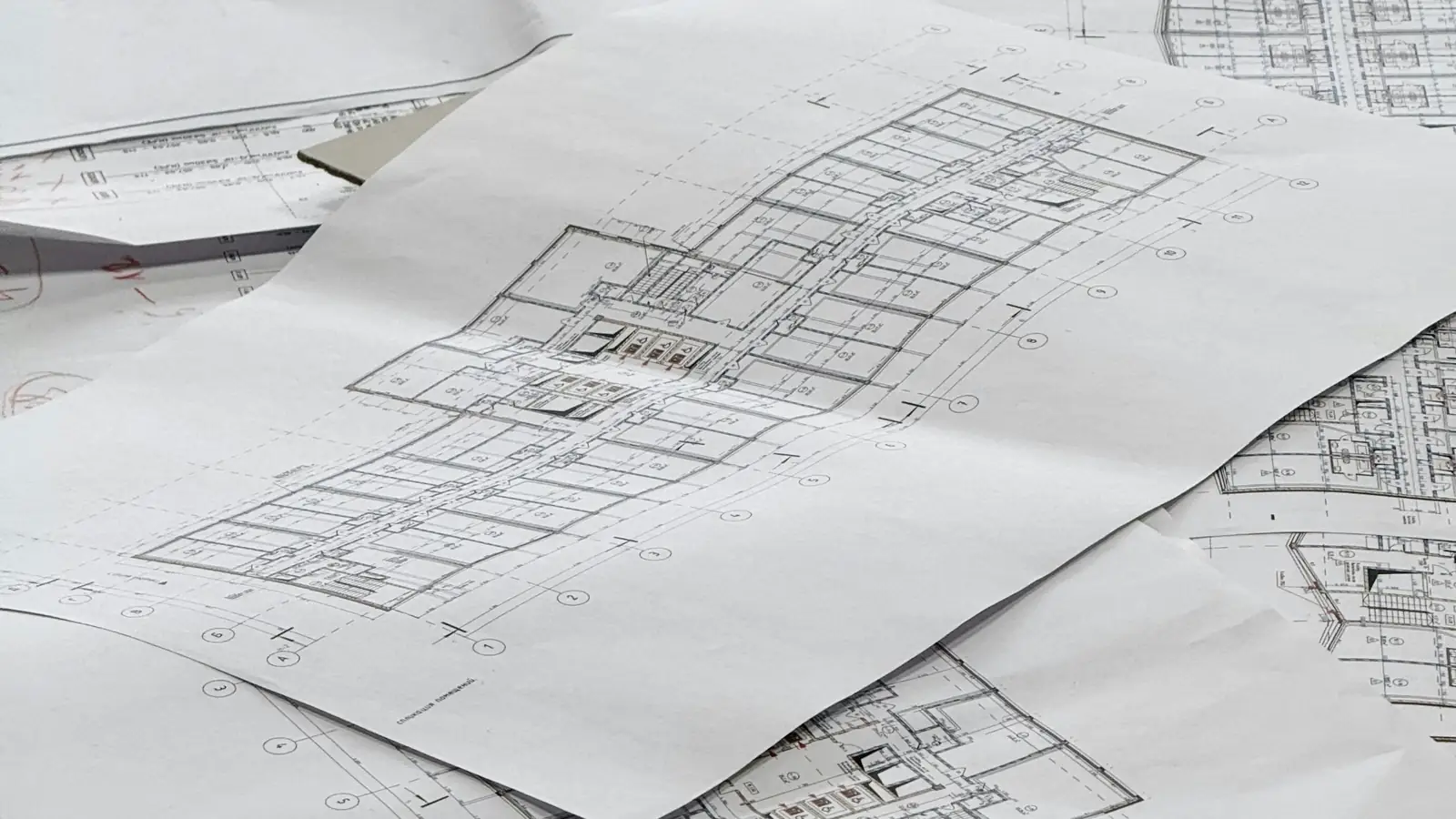
How much does it cost to replace plumbing in an old house?
There is no single national figure. The cost to replace plumbing in an old house depends on linear feet of pipe by material and diameter, fixture count, wall and floor access, permit fees and disposal. A takeoff priced from measured quantities and reviewed by an estimator shows where the money actually goes.
What the Cost to Replace Plumbing in an Old House Actually Covers
The cost to replace plumbing in an old house is built from four separable scopes, and a bid that bundles them without a breakdown cannot be compared to another bid. The first is the water service line from the main water shutoff or the meter to the building entry. The second is the distribution piping that runs from that entry to every fixture. The third is the drain, waste and vent system, from fixture trap arms through the branch lines and the stack to the building drain. The fourth is the patching and access work that follows demolition.
A whole house repipe cost is quoted against a defined fixture count and a measured pipe length, so ask each bidder for the fixture schedule and the linear footage behind the number. When homeowners ask how much does it cost to redo plumbing in an old house, the honest answer is that no single rate applies until the accessible versus concealed split is known. A repipe that runs through an open basement is a different job from one that opens finished walls on two floors. Our plumbing quantity takeoff service shows the quantity, unit and rate for each scope so you can see which bidder measured what.
Supply lines vs. drain, waste and vent lines
Supply piping is priced by linear foot of pipe plus a fitting allowance per fixture; copper Type L is commonly specified where the client wants a soldered or press system with a long service life. Drain, waste and vent work is priced by developed length of pipe and by fitting count, because every change in direction adds a fitting and every fixture adds a trap arm and vent connection. The two scopes carry different labor rates and different permit line items, so keep them on separate lines in the estimate. A supply-only repipe leaves the cast iron or galvanized drain in place, and that decision should be stated in writing.
What is usually excluded (fixtures, wall repair, permits)
Most repipe quotes exclude the fixtures themselves, the shower valve trim, the water heater, and the finish repair after the drywall patch. Permit fees are sometimes carried by the contractor and sometimes passed through, and the line should name the authority having jurisdiction. Access cuts, drywall patch, texture and paint are frequently a separate trade, which means the plumbing bid and the repair bid must be read together. Ask for a written exclusion list, then price the exclusions yourself before you compare totals.
How Old-House Pipe Material Sets the Baseline
The existing material decides how much demolition the job needs, how the new pipe gets from the basement to the second floor, and whether a partial replacement is even allowed by the local inspector. Galvanized steel pipe that has been in service for decades typically shows internal scale and reduced bore, so a repair at one section often fails at the next joint. Cast iron drain pipe in a pre-war house may be bell-and-spigot with leaded joints, which changes the cut-and-couple method and the fittings you can source. For a first-pass range, the replace galvanized pipes cost driver is the number of fixtures fed and the length of the runs, not the square footage of the house.
Galvanized steel and cast iron
Galvanized supply lines are cut out in sections and replaced back to a dielectric union at each transition to copper or brass. Cast iron drain waste vent stacks are usually replaced from the fixture branch up through the roof penetration, and the roofer may need to flash the new vent boot. Expect demolition labor to run higher than new-construction rough-in labor on the same footage because of cutting, threading and disposal. A repipe house cost per fixture figure that ignores the drain side will understate the job whenever the stack is being replaced.
Polybutylene and lead service lines
Polybutylene supply pipe and lead water service lines are the two materials that most often push a repair into a full replacement. Polybutylene has a history of fitting failures, and insurers and inspectors commonly treat it as a material to remove rather than splice. A lead service line is replaced from the main to the meter, and the utility should be contacted before excavation because the ownership line between public and private pipe varies by jurisdiction. Neither material should be joined to a new system with a push-fit SharkBite fitting buried in a wall; keep any mechanical connection accessible.
Copper vs. PEX for the replacement
Copper Type L is priced off the copper market, and the producer price data in the chart below shows how much that input has moved in the past year. PEX-A and PEX-B are priced off plastic resin, which has moved far less over the same period, and both install faster because fewer joints are needed. Copper needs soldering or press fittings and a fire watch in some occupancies; PEX needs a manifold or a trunk-and-branch layout and protection from sunlight and physical damage. The material choice is a line-item decision, and the estimator should show both options at the same fixture count. Reviewing common plumbing estimating errors before you commit to one material will save a change order later, and our trade estimating services can carry both options through the takeoff.
Worked Example: Repipe of a 1,800 Sq Ft Two-Bath House
This is an illustrative old house plumbing replacement estimate, not a market average. Every rate below is a stated input you can replace with your own pricing, and the arithmetic is shown so you can check it. The scenario is a cost to replace plumbing lines in a 1950s house where the supply is polybutylene and the drain stack is cast iron. The house is 1,800 sq ft with 2.5 baths and 14 fixtures, with 120 linear foot of accessible basement run and 60 linear foot of concealed second-floor run. Supply is priced at $9.50 per linear foot installed in PEX-B and drain at $22.00 per linear foot in cast iron with no-hub couplings; fixture rough-in is $310 each, and the water service line from the curb stop to the main shutoff is a single $1,850 line. Material, labor, access and permit are carried as separate lines so a change in one does not hide inside another. Use the calculator below to test how a loaded labor rate changes the total when burden and overtime shift.
| Line item | Quantity | Unit | Unit price | Extended |
|---|---|---|---|---|
| Supply pipe, PEX-B, accessible basement | 120 | LF | $9.50 | $1,140 |
| Supply pipe, PEX-B, concealed second floor | 60 | LF | $9.50 | $570 |
| Drain, cast iron no-hub, stack and building drain | 85 | LF | $22.00 | $1,870 |
| Fixture rough-in, 14 fixtures | 14 | EA | $310.00 | $4,340 |
| Water service line, curb stop to main shutoff | 1 | LS | $1,850.00 | $1,850 |
| Access cuts, drywall patch and paint | 1 | LS | $2,400.00 | $2,400 |
| Permit fee and hydrostatic test | 1 | LS | $650.00 | $650 |
| Subtotal | $12,820 | |||
| Contingency, 10% | $1,282 | |||
| Illustrative total | $14,102 |
Loaded labor rate calculator
- Loaded rate
- $31/hr
- Blended with overtime
- $32/hr
- Labor hours
- 320
- Crew labor cost
- $10,279
Burden covers payroll taxes, workers’ compensation, insurance and benefits; it varies by state, trade and company. Overtime is priced at time and a half.
Where the total lands and why
The subtotal before contingency is the sum of the material, labor, access and permit lines. A 10 percent contingency is added for concealed conditions such as a rotted sill at the vent penetration or an unrecorded remodel behind a tiled wall. The total lands where it does because the concealed second-floor run brings the access cuts with it, while the accessible basement run needs no wall or ceiling repair. Note that the 60 linear foot of concealed run is billed twice in effect: once as pipe and once as drywall patch and paint, which is why the access line is not a rounding item. Send your plans through request a project quote and we will show the same line structure against your actual fixture count and pipe lengths.
What Drives the Price Up or Down
Two houses of the same square footage can land hundreds of labor hours apart on a repipe. The variables below are the ones that move the number most, and each one shows up on the sheet as either labor hours, access and repair cost, or both. When we build a line-item takeoff, each driver gets its own row so you can see the assumption instead of accepting a lump sum.
Pipe material sits on top of all of them. A cost to repipe a house with pex runs well under a copper repipe cost per linear foot, because PEX is priced per roll and joined with crimp or expansion fittings, while copper is priced per foot of tube plus solder or press fittings and far more handling time. A cast iron drain that stays in place avoids demolition; a cast iron drain that comes out adds cutting, hauling, and new PVC or ABS in its place.
Access: basement, crawlspace, slab, or plaster walls
An open basement with an exposed joist bay is the cheapest repipe you can draw: the plumber works overhead, and the only repair is patching holes at each fixture drop. A crawlspace adds crawling time and often a vapor barrier that has to be pulled back and reset. Slab-on-grade is the expensive case, because supply lines under the slab mean saw-cutting, breaking, hauling, and patching concrete, and any reroute through the attic adds insulation and drywall work.
Wall finish matters as much as structure. Lath-and-plaster walls break out in larger, irregular patches than drywall and cost more per square foot to repair, so an old house plumbing replacement estimate carries a separate patching line rather than burying it in the pipe price. Count the wet walls first: two baths back to back on one wet wall is a short run, while fixtures spread across three walls multiply the openings.
Fixture count and bathroom clusters
Price the work per fixture, not per house. Each fixture carries a supply rough-in, a drain connection, and a trap arm, and a toilet, lavatory, tub, and kitchen sink are four separate assemblies even when they share a stack. Grouping fixtures on shared walls cuts pipe length and the number of wall openings, which is why a stacked two-bath layout prices lower than the same fixture count spread across a single-story plan.
Water heaters, hose bibs, laundry boxes, and the main water shutoff each add a line. A full replacement that also moves fixtures is a different scope from a like-for-like repipe, and the takeoff should state which one you are buying.
Occupancy, phasing, and permit requirements
An occupied house is worked around, not through. The crew protects floors, shuts water off in stages, and returns each day to a live bathroom, which adds setup and travel hours that an empty house never sees. Phasing a repipe in two or three visits to keep one bath working adds mobilization cost, and it is a legitimate line on the estimate.
Permit and inspection rules are local. Many jurisdictions require a permit for a whole-house repipe and a hydrostatic or water pressure test before the walls close, and some require lead service line evaluation on the water service line. Confirm the code edition and inspection sequence with the building department before you price, and carry the permit fee and inspection visits as their own rows. Our line-item plumbing estimating keeps access, patching, and permit costs visible instead of folded into a per-fixture average.
Partial Repipe vs. Full Replacement: Reading the Numbers
A partial repipe replaces the runs that have already failed or are most likely to fail next. A full replacement takes out every supply and drain line in one mobilization. Compare them on the same line-item structure, because a section repair that looks cheap on the invoice can cost more per fixture once you count the second mobilization, the second permit, and the second round of wall patching. Building the comparison on a single residential construction estimate keeps both options on identical units and quantities.
The decision usually comes down to pipe condition and access. Galvanized steel that is failing at one fitting is failing at the next one, and polybutylene is a whole-system problem rather than a joint problem. Where the accessible pipe is sound and the concealed runs are dry, a section repair is defensible. Where the failure is inside a slab or a plaster wall, the cost to replace plumbing in an old house moves toward full replacement because opening the assembly twice costs more than opening it once.
| Line item | Unit | Partial repair (qty) | Full repipe (qty) | What changes the number |
|---|---|---|---|---|
| Demolition and wall opening | square foot of patch | 18 | 95 | Plaster versus drywall; slab cutting |
| Supply pipe, PEX-A | linear foot | 24 | 310 | Attic reroute versus slab |
| Drain pipe, PVC replacing cast iron | linear foot | 8 | 120 | Slope per foot and cleanout count |
| Fixtures reconnected | per fixture | 1 | 6 | Bathroom clusters on shared wet walls |
| Permit and inspection | each | 1 | 1 | Local rule on whole-house repipe |
| Wall and floor patching | square foot | 18 | 95 | Texture match on lath and plaster |
Contingency range by estimate class
- Low contingency
- $150,000 (10%)
- High contingency
- $300,000 (20%)
- Budget range
- $1,650,000 – $1,800,000
Typical planning ranges that follow the AACE estimate-class idea: less design, more contingency. Set the final figure from a risk review of your own project.
When a section repair is defensible
A section repair earns its place when the failed run is short, exposed, and isolated. Replacing a corroded stub between the main water shutoff and the first branch, or a single trap arm and its fitting, is a few hours of work with one wall opening. The same logic holds for a cast iron drain replacement cost on one horizontal run in an open basement, where the pipe is cut out and replaced with PVC without touching the stacks.
Set a boundary before you start: if the repair opens a wall and finds a second material transition, the scope changes and the change order should be priced from the same unit rates as the original bid.
When full replacement is cheaper over the job
Full replacement wins when the pipe is at end of life throughout, when several wet walls are involved, or when the house is already open for another renovation. One mobilization, one permit, one set of patches, and one pressure test beat three separate service calls. A whole-house repipe also lets the plumber correct slope per foot on drain runs, add cleanouts, and reroute supply in pex-a or pex-b through the attic to avoid slab work entirely.
Every full replacement carries concealed-condition risk: what the wall reveals once it is open. Use the calculator below to see how the AACE estimate class you are working in widens the budget range around the base estimate, and carry the high side until the walls are open and the rough-in is verified.
Getting a Traceable Plumbing Replacement Estimate
A bid you can audit shows the unit, the quantity, and the rule behind the quantity. A bid you cannot audit shows a total. Ask each bidder for the same five things and the proposals become comparable line by line, which is the whole point of a measured quantity takeoff done before pricing.
Material choice drives the largest single swing. A polybutylene pipe replacement cost depends on whether the replacement is pex-b, pex-a, or copper, and each carries a different fitting system and labor rate. The water service line from the meter to the house is its own scope, often with a lead service line question attached, and cleanouts added during a drain replacement are priced individually.
Questions to ask each bidder
Ask for the unit basis on every pipe and fitting line, whether it is linear foot, per fixture, or each. Ask how many labor hours are carried per fixture and what production rate that assumes. Ask whether wall and floor patching is included or excluded, and at what square-foot rate. Ask what permit and inspection line is carried and who pulls the permit. Ask what contingency is built in and which AACE class the estimate is written to.
A bidder who cannot answer the first two questions is pricing from memory. Our plumbing estimating team produces the line-item workbook and marked-up drawings that make those answers checkable.
What a defensible line item looks like
A defensible line reads: 3/4-inch PEX-B supply, 310 linear feet, measured from the main water shutoff to each fixture drop, priced at a stated unit rate, with fittings and hangers listed separately. A drain line reads: 3-inch PVC replacing cast iron drain, 120 linear feet, at a stated slope per foot, with cleanouts counted each. Patching reads in square feet of wall and floor opened, and the permit reads as a fee plus inspection visits.
When the scope includes moving fixtures or opening finished rooms, pair the repipe with remodeling and renovation estimates so the patch, finish, and trim work sit on the same sheet as the pipe. If you have plans and photos of the existing system, send your plans and we will quote the takeoff per project.
Frequently Asked Questions
How much does it cost to replace plumbing in an old house?
There is no single national figure because the cost to replace plumbing in an old house depends on pipe material, accessible linear footage, fixture count, and how much wall and floor opening the route requires. A useful estimate starts as a quantity takeoff: feet of supply and drain line by material, number of fixtures and shutoffs, and demolition and patch allowances. We quote the fee per project after reviewing plans.
Is it cheaper to repipe a house with PEX or copper?
PEX is generally cheaper than copper Type L on both material and labor, because fewer fittings and no soldering are needed. Copper still wins where local code, insurance, or a visible-exposed run calls for it. The gap narrows when a PEX job needs many transition fittings at the water heater and main shutoff. Compare the two as separate line items on the same takeoff.
Does replacing plumbing in an old house require opening walls?
Usually some walls open, but not every wall. Supply and drain lines can often be fished through chases, attics, and basements, with openings cut only at fixture locations, the main water shutoff, and each vent stack tie-in. Horizontal drain runs need slope per foot, which sometimes forces soffit or ceiling openings. Count drywall patch and paint as separate line items, not hidden in the plumbing price.
How long does a whole-house repipe take?
Duration depends on house size, pipe material, the number of fixtures, and whether drains are replaced along with supply lines. Access and inspection scheduling move the date more than crew size does. We confirm the estimate delivery date with the quote, and the contractor sets the construction schedule after permit issuance.
Should I replace plumbing before or after a renovation?
Replace plumbing before finishes go in. Rough-in work needs open framing, and running new lines after tile, cabinets, and flooring are installed multiplies patch and rework cost. Sequence the repipe after demolition and before insulation and drywall. If the renovation is partial, isolate the repipe scope so change orders do not blur which trade opened which wall.
Does homeowners insurance cover plumbing replacement in an old house?
Most policies cover sudden accidental damage, such as a burst supply line, but not the replacement of worn galvanized, polybutylene, or failing cast iron drains. Read the exclusion for deterioration and wear and tear before you budget. Ask the adjuster in writing what is covered, and keep the plumber's written condition report for the claim file.
Can you use my estimate template?
Send the template with the plans and we confirm whether the estimate can be delivered in it. The line structure, units, and measurement rules in your template are reviewed before plan review begins. Anything the template cannot carry, such as marked-up drawing pages, is delivered alongside it.