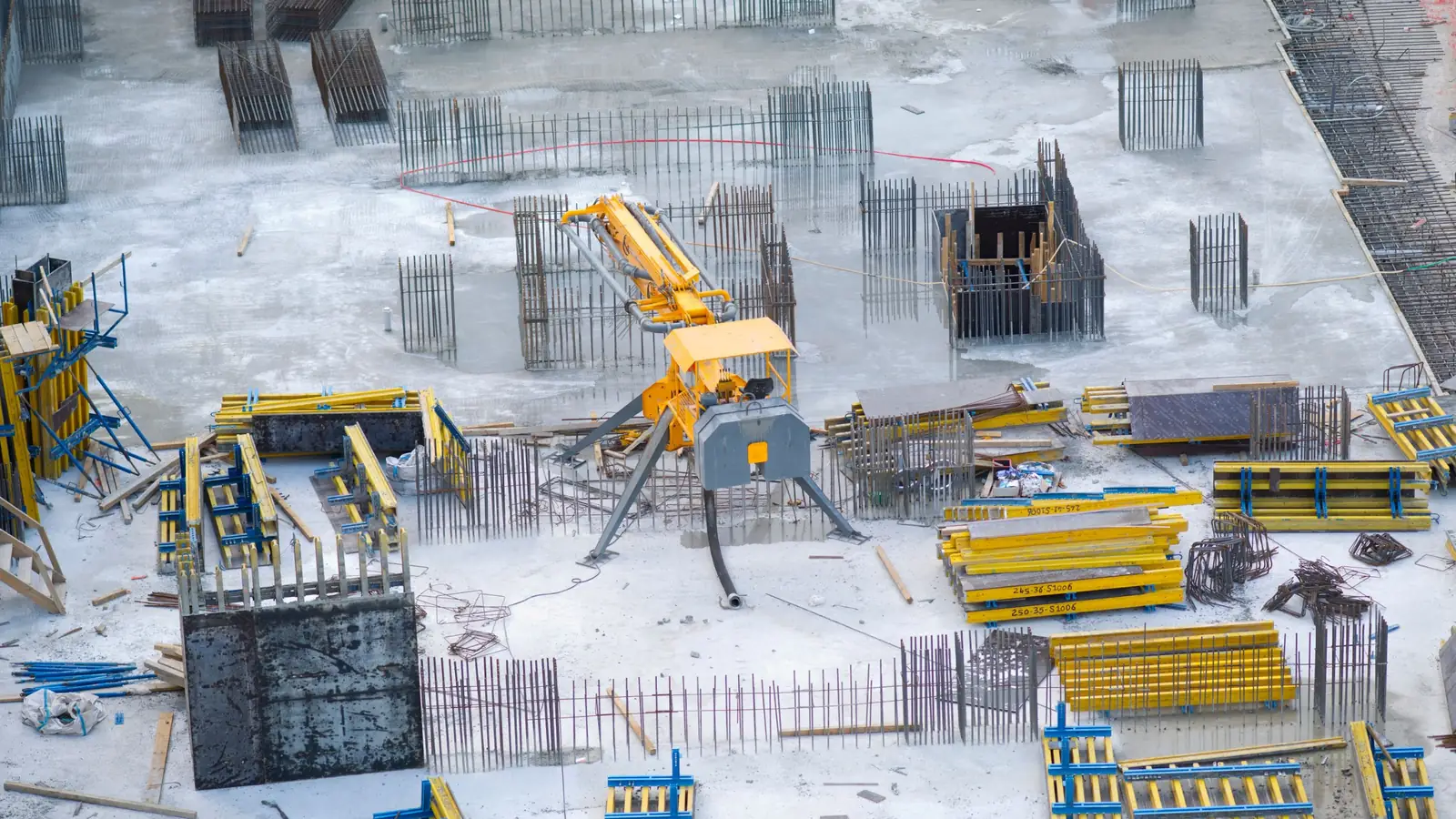
How much is a yard of concrete?
The cost of a yard of concrete is set by the ready-mix producer's quote for your mix design plus delivery, short load and fuel charges, then labor, rebar, forms and finishing on top. Ready-mix pricing moved only modestly in the past year, while steel and lumber inputs moved far more, so the mix and reinforcement in your drawings matter more than the concrete itself.
What the Cost of a Yard of Concrete Actually Buys
A cubic yard is 27 cubic feet, and that is the only unit a ready-mix producer prices. When a contractor asks how much is a yard of concrete, the honest answer depends on which line of the quote they are reading: the material line, the delivery line, or the placement line. The cost of a yard of concrete in a bid is the sum of all three, divided by the yards placed.
A 4-inch slab on grade consumes 0.0123 cubic yards per square foot (1 sq ft × 0.333 ft ÷ 27). That conversion is the bridge between a plan measured in square feet and a delivery ticket measured in cubic yards, and it is the first line item in any construction quantity takeoff.
Volume, not area: the cubic-yard unit
One cubic yard covers 81 sq ft at 4 inches thick, 108 sq ft at 3 inches, and 65 sq ft at 5 inches. Thickness in inches drives the number, so a slab called out at 4 inches on the structural sheet and 5 inches at the apron produces two different volumes from the same footprint. Build the volume from net dimensions first, then apply a waste factor for spillage, over-excavation, and pump priming. Typical waste on a formed slab runs 5% to 10%; a footing or wall pour with uneven subgrade sits at the top of that range.
What's inside a ready-mix quote (and what isn't)
A producer's concrete price per yard delivered covers cement, aggregate, water, and the batch plant's overhead. The quote normally states compressive strength in psi, slump at the point of discharge, maximum aggregate size, and any admixture such as an accelerator or retarder. Wire mesh or fiber reinforcement, vapor barrier, gravel base, formwork, rebar, screeding, bull float, control joints, and curing are separate line items — they belong to the finishing and reinforcement trades, not the batch ticket.
The delivery ticket is the audit trail. It records the mix design, the yards batched, the time on site, and any water added at the chute. Compare that ticket to the quote before you approve an invoice, and keep both with the estimate file. Our concrete takeoff and estimating support builds that paper trail into every takeoff we return, and the same line-item discipline carries into how to estimate construction projects as a general contractor.
How Much Does a Yard of Concrete Cost? Breaking Down the Quote
A ready-mix quote is a stack of line items, and the base mix price is only the first. Read the sheet from top to bottom and you will find a per-cubic-yard material rate, a delivery or standing-time charge, a short-load premium when the order falls under the plant's minimum, and per-yard add-ons for fibers, air entrainment, pumps, and color. Each one changes the concrete cost per cubic yard you actually pay.
Material input prices move. The chart below tracks the BLS Producer Price Index series for ready-mix concrete, steel mill products, and lumber and wood products, rebased to 100 at the start of the series, so you can see how the three inputs have diverged over the period rather than reading a single national average. Ready-mix has moved modestly; steel, which feeds rebar and mesh, has swung far more, and lumber tracks formwork. A quote built on a rate sheet from last year will miss that spread.
Material, delivery, and short-load charges
Delivery is priced per truck, per yard, or per hour of standing time, depending on the plant. A short load fee applies when the order is below the plant's minimum — commonly 3 to 5 cubic yards on a standard mixer — because the batch plant charges for the truck either way. Fuel surcharges appear as a separate percentage line on many tickets. Sales tax applies to materials in most states and to some services in a few, so confirm the treatment with the producer's billing office.
Add-ons: fibers, air entrainment, pumps, color
Fiber reinforcement is priced per yard of mix, air entrainment per yard for exterior flatwork in freeze-thaw climates, and color per yard or per bag of pigment. A concrete pump is a mobilization charge plus a per-yard rate, and it usually replaces the wheelbarrow labor line rather than adding to it. Run the quantities through a concrete yard calculator before you call the plant; the order quantity, not the net volume, is what the short-load threshold is tested against. A full construction quantity takeoff of the pour strips and footings keeps that order accurate, and a worked quantity takeoff example shows how the same rules apply line by line.
Material price movement, Oct 2023 to Sep 2026
Material, delivery, and short-load charges
Delivery is priced per truck, per yard, or per hour of standing time, depending on the plant. A short load fee applies when the order is below the plant's minimum — commonly 3 to 5 cubic yards on a standard mixer — because the batch plant charges for the truck either way. Fuel surcharges appear as a separate percentage line on many tickets. Sales tax applies to materials in most states and to some services in a few, so confirm the treatment with the producer's billing office.
Add-ons: fibers, air entrainment, pumps, color
Fiber reinforcement is priced per yard of mix, air entrainment per yard for exterior flatwork in freeze-thaw climates, and color per yard or per bag of pigment. A concrete pump is a mobilization charge plus a per-yard rate, and it usually replaces the wheelbarrow labor line rather than adding to it. Run the quantities through a concrete yard calculator before you call the plant; the order quantity, not the net volume, is what the short-load threshold is tested against. A full construction quantity takeoff of the pour strips and footings keeps that order accurate, and a worked quantity takeoff example shows how the same rules apply line by line.
Worked Example: Cost of a Yard of Concrete for a 24' × 30' Slab
Assume a 24' × 30' slab on grade at 4 inches thick, 10% waste, wire mesh in lieu of rebar, and a direct pour from the truck with no pump. Every rate below is illustrative and labeled as such; substitute your own plant quote and your own crew rates. The point is the sequence, not the number.
Quantities: volume, waste, and rebar
Area is 24 × 30 = 720 sq ft. Thickness in inches converts to 4 ÷ 12 = 0.333 ft. Volume is 720 × 0.333 = 240 cubic feet, and 240 ÷ 27 = 8.89 cubic yards net. With a 10% waste factor, 8.89 × 1.10 = 9.78 cubic yards, so you order 10 yards. At 6 × 6 wire mesh on a 10% lap allowance, 720 sq ft × 1.10 = 792 sq ft of mesh, sold in 5' × 150' rolls of 750 sq ft, so two rolls cover it.
Arithmetic from cubic yards to total cost
The table shows the illustrative build-up. Ready mix concrete price per yard is assumed at $185.00, delivery at $150.00 flat, and no short load fee because 10 yards clears a typical minimum. Mesh is priced at $0.18 per sq ft, formwork at $2.25 per linear foot around the 108-ft perimeter, and labor at crew hours times the published wage. The cost of concrete per yard installed comes out at the bottom, dividing the total by the 8.89 net yards. Labor hours are illustrative: 0.06 cement mason hours and 0.05 laborer hours per square foot, which is 43.2 and 36.0 hours respectively at 720 sq ft.
| Line item | Quantity | Unit | Rate | Amount |
|---|---|---|---|---|
| Ready-mix concrete, 4,000 psi | 10.00 | cu yd | $185.00 | $1,850.00 |
| Delivery charge | 1 | load | $150.00 | $150.00 |
| Short load fee | 0 | load | $0.00 | $0.00 |
| Wire mesh 6x6, 10% lap | 792 | sq ft | $0.18 | $142.56 |
| Formwork, perimeter | 108 | lin ft | $2.25 | $243.00 |
| Cement mason labor, 43.2 hr | 43.2 | hr | $27.41 | $1,184.11 |
| Construction laborer, 36.0 hr | 36.0 | hr | $22.66 | $815.76 |
| Total installed | 8.89 | cu yd net | — | $4,385.43 |
Slab quantity takeoff
- Area
- 2,400 sq ft
- Volume
- 800 cu ft
- Net concrete
- 29.63 cu yd
- Order quantity
- 31.11 cu yd
Formula: length × width × (thickness ÷ 12) ÷ 27 = cubic yards. Thickened edges, footings and pump waste are taken off separately.
Quantities: volume, waste, and rebar
Area is 24 × 30 = 720 sq ft. Thickness in inches converts to 4 ÷ 12 = 0.333 ft. Volume is 720 × 0.333 = 240 cubic feet, and 240 ÷ 27 = 8.89 cubic yards net. With a 10% waste factor, 8.89 × 1.10 = 9.78 cubic yards, so you order 10 yards. At 6 × 6 wire mesh on a 10% lap allowance, 720 sq ft × 1.10 = 792 sq ft of mesh, sold in 5' × 150' rolls of 750 sq ft, so two rolls cover it. Fiber reinforcement is a per-yard add-on if the specification calls for it instead of mesh; it does not replace the vapor barrier or the gravel base line.
Arithmetic from cubic yards to total cost
The table shows the illustrative build-up. Ready mix concrete price per yard is assumed at $185.00, delivery at $150.00 flat, and no short load fee because 10 yards clears a typical minimum. Mesh is priced at $0.18 per sq ft, formwork at $2.25 per linear foot around the 108-ft perimeter, and labor at crew hours times the published wage. The cost of concrete per yard installed comes out at the bottom, dividing the total by the 8.89 net yards. Labor hours are illustrative: 0.06 cement mason hours and 0.05 laborer hours per square foot, which is 43.2 and 36.0 hours respectively at 720 sq ft.
What Drives the Price of a Yard of Concrete
A ready-mix quote is not one number. It is a cement price, an aggregate price, a haul charge, a plant minimum, and a labor rate stacked into a single cubic-yard figure. The producer's batch plant sets the first two; the distance from that plant to your gate sets the third. That is why two projects of identical volume in the same metro can carry different concrete delivery cost per yard.
Order size is the lever most owners miss. A plant prices a full truck economically because the drum, driver and batching time are paid once. A three-yard pour on the same truck carries a minimum load charge, and the short-load premium is usually the largest single line on a small ticket. Rounding a footing order up to the next full yard is often cheaper than paying the minimum twice.
Volume also decides how waste is priced. Order the neat quantity and you risk a cold joint at the last form; order too much and the extra yard is dumped. A typical waste factor of 5% to 10% on slab-on-grade work absorbs form bow, subgrade variation and spillage. The same logic applies to accessories: a vapor barrier under a slab is priced per square foot of coverage, not per yard of concrete, so it belongs on its own line rather than buried in the mix price.
Region, plant distance, and order size
Cement and aggregate are heavy and cheap per ton, so freight is a real share of the delivered price. A site 40 miles from the nearest plant pays more per yard than one across the road, and urban plants with limited batch windows price accordingly. Ask the producer for the plant name on the quote and confirm the haul distance yourself. Order size then interacts with that haul: a 10-yard load to a distant site is priced differently from a 10-yard load nearby because the truck is out of service longer. Fuel surcharges travel with the delivery line, and sales tax treatment varies by state and by whether the concrete is sold to a contractor or a taxable end user.
Mix design, strength, and season
Compressive strength drives cement content, and cement is the costliest ingredient. A 2,500 psi fill mix and a 4,500 psi structural mix are different products at different prices per yard. Admixtures add cost line by line: air entrainment for freeze-thaw exposure, water reducers for slump control, accelerators for cold weather, retarders for hot weather, and fiber reinforcement in place of wire mesh. Winter work can add heated water and blankets; summer work can add ice or retarder to hold slump on the ride. Confirm the specified strength, slump and air content against ACI 318 and the project specifications before you compare two quotes, because a cheaper yard at lower strength is not the same product.
Yard of Concrete vs Square Foot: Converting Without Guesswork
Concrete is bought by the cubic yard and placed by the square foot, and most quantity errors start at that boundary. One cubic yard is 27 cubic feet. Divide 27 by the slab thickness in feet and you get how many square feet does a yard of concrete cover at that depth. Thickness in inches converts to feet by dividing by 12, so 4 inches is 0.333 feet and 27 ÷ 0.333 = 81 square feet.
Run the conversion the other way to budget. Take the slab area, multiply by thickness in feet to get cubic feet, divide by 27 to get cubic yards, then apply your waste factor. That sequence is the same one behind any construction quantity takeoff, and it is worth writing into the estimate sheet so the next reviewer can follow it. A concrete yard calculator does the arithmetic, but the estimator still has to confirm the thickness, the subgrade and the edge forms.
The calculator below converts a square-foot budget into a total project budget; it does not price concrete. Use it after you have a hard cost per square foot, then carry the yardage separately from the coverage table. When the same conversion has to hold across several pours and trades, our estimating support for trade contractors keeps each line item on one measurement rule.
| Slab thickness | Thickness in feet | Square feet per cubic yard | Cubic yards per 1,000 sq ft |
|---|---|---|---|
| 3 in | 0.25 | 108 | 9.26 |
| 4 in | 0.333 | 81 | 12.35 |
| 5 in | 0.417 | 65 | 15.43 |
| 6 in | 0.50 | 54 | 18.52 |
| 8 in | 0.667 | 40 | 24.69 |
| 10 in | 0.833 | 32 | 30.86 |
| 12 in | 1.00 | 27 | 37.04 |
Square-foot budget calculator
- Hard cost
- $444,000
- Soft costs
- $53,280
- Contingency
- $49,728
- Escalation
- $21,880
- Budget total
- $568,888
- All-in per sq ft
- $237
Enter your own base rate from a recent bid, cost book or estimator. The default values are placeholders for the math, not market prices.
Thickness determines coverage
Every coverage figure is a thickness assumption in disguise. At 4 inches a yard covers 81 square feet; at 5 inches it covers about 65; at 6 inches it covers 54. Change the slab from 4 to 6 inches and you need half again as many yards for the same footprint. That is why a plan review that skips the thickness callout can miss the concrete quantity by 50%. The gravel base beneath the slab is measured separately in cubic yards of compacted stone, and the vapor barrier in square feet with lap allowance, so neither belongs in the concrete coverage figure.
Common thickness conversions
The table below holds the coverage figures an estimator uses most, with the division shown so each row can be checked. Add the waste factor after coverage, not before, so the ordered yards reflect the actual pour. Then price the placement side: a concrete finisher's hours scale with square feet of surface, not with yards, so a thin slab and a thick one of equal area carry similar finishing labor. The wage table below shows the BLS median hourly rates for cement masons and construction laborers, which is the input a labor line should be built from.
Where Concrete Quotes Go Wrong — and How to Verify Yours
Most concrete quotes that fail do not fail on the mix price. They fail on scope: a yard count that ignored thickness, a pump charge that appeared after award, or a slab priced twice under two line items. A concrete slab cost per yard that looks low usually means placement, finishing, reinforcement or base is sitting somewhere else in the bid or missing entirely. Read the quote as a set of line items and ask which trade owns each one.
The fastest check is arithmetic. Recompute cubic yards from the drawing dimensions, apply your waste factor, and compare to the quantity on the ticket. Then check the labor: a cement mason's hours should scale with square feet of finish, and formwork should be measured by contact area, not by slab area. If the numbers reconcile, the quote is defensible; if they do not, you have found the gap before the pour.
Waste, overage, and short-load traps
Waste is routinely omitted on small pours because the estimator rounds to the nearest yard instead of applying a percentage. On a 12-yard slab, a 7% waste factor adds 0.84 yards, which becomes a full yard on the order. Short-load and minimum load charges then punish splitting a pour across two trucks when one would do. Pump charges, standby time and extra chute sections are separate line items on most delivery tickets, and the delivery ticket itself is the document that settles the final quantity, so keep every one and reconcile against the invoice.
Checking quantities against drawings
Pull the slab thickness, the psi and air-entrainment callouts, and the reinforcement schedule from the structural sheets, then confirm them against the specifications. Footings, grade beams and slab-on-grade are separate quantities with separate waste and formwork allowances, and mixing them into one yard figure hides errors. A structured quantity takeoff keeps each item on its own line with unit, measurement rule and source sheet noted. If your team is short on review time, our concrete estimating services produce a line-item takeoff you can check against the bid, and the same method is described in this construction quantity takeoff example.
FAQ: Cost of a Yard of Concrete
The questions below come up on nearly every residential flatwork inquiry we price. Each answer ties back to a line item you can check on a delivery ticket or an estimate sheet, and to the 24' × 30' slab used in the worked example above. Where a number depends on your market, we name the driver instead of quoting a figure that would be stale by the time you read it.
How much is a yard of concrete? A cubic yard is 27 cubic feet, or the volume of a slab 27 square feet at 12 inches thick, 54 square feet at 6 inches, or 81 square feet at 4 inches. Price per cubic yard is set by the ready-mix producer, not the finisher, so ask for the mix design and the quoted unit price separately. Our concrete volume takeoff walkthrough shows the volume arithmetic before any price is applied.
What is a short load concrete fee? Producers charge a minimum load or short load concrete fee when an order falls below a set volume, because the batch plant, drum and driver are committed either way. Confirm the threshold in cubic yards and whether it is charged per load or per yard short. On a small footing pour, this fee can exceed the concrete itself.
How many square feet does a yard of concrete cover? Divide 27 by the thickness in feet. At 4 inches (0.333 feet) a yard covers about 81 square feet; at 5 inches, about 64.8; at 6 inches, about 54. Add a waste factor of roughly 5 to 10 percent on formed work, and never round down on a pump or conveyor pour.
Does reinforcement change the cost of a yard of concrete? It changes the installed cost, not the ready-mix price. Wire mesh or #4 rebar unit pricing is a separate line item in Division 03, and steel mill products moved sharply in the PPI over the past year, so re-price reinforcement at bid time rather than carrying an old allowance.
What about air entrainment and finishing? Air entrainment, slump and admixtures are specified in the mix design and priced into the yard; screeding, bull floating, control joints and curing are labor. Cement mason wages and productivity set that portion, so a 4-inch slab and a 6-inch slab with the same square footage can carry very different finishing hours.
To start, request a free quote and attach your drawings.
Frequently Asked Questions
How much does a yard of concrete cost?
The cost of a yard of concrete is not a single published figure. It combines the producer's price for ready mix at a stated strength, slump and air content, plus delivery, a possible short-load or minimum-load charge, fuel surcharge, sales tax, and the labor and materials to place and finish it. Read the quote line by line, because each of those items moves independently of the others.
How many square feet does a yard of concrete cover?
One cubic yard covers 324 square feet at 1 inch thick, 162 square feet at 2 inches, 108 square feet at 3 inches, and 81 square feet at 4 inches. Divide 324 by the thickness in inches to get coverage. A 4-inch slab on grade is the common residential default, but confirm the specified thickness on the drawings before you convert.
Is it cheaper to order concrete by the yard or by the truck?
Ready mix is sold by the cubic yard, and a full truck typically carries about 8 to 10 cubic yards; the truck is the delivery method, not a separate pricing unit. Ordering full loads spreads the minimum-load charge and the delivery charge over more yards, so the price per yard falls as the load size rises toward a full truck.
What is a short-load fee on concrete delivery?
A short-load fee, sometimes called a minimum-load charge, is billed when the order is smaller than the producer's minimum quantity, commonly under 4 to 5 cubic yards. The producer still dispatches a truck and a batch, so the fixed cost is recovered on fewer yards. Ask the producer for the threshold and the charge before you finalize the order quantity.
How much does a yard of concrete weigh?
Normal-weight concrete weighs roughly 4,000 pounds per cubic yard, or about 2 tons. The figure moves with the mix: air entrainment lowers it slightly, while heavier aggregates raise it. Weight matters for truck axle limits, slab-on-grade subgrade loading, and any elevated deck or formwork design, so confirm the design mix rather than assuming 4,000 pounds.
How do I calculate how many yards of concrete I need for a slab?
Multiply length by width by thickness, all in feet, then divide by 27 to convert cubic feet to cubic yards. Add a waste factor, typically 5 to 10 percent for a formed slab on grade. For a 24 by 30 foot slab at 4 inches, that is 240 cubic feet, or 8.89 cubic yards before waste.
Can you use my estimate template?
Send the template along with the drawings, and we confirm whether the estimate can be delivered in it. The line items, units and measurement rules are set by the plans and the scope, so the template is reviewed against those before any work is scheduled.
Do you sign NDAs before reviewing drawings?
Clients can request a nondisclosure agreement before sending drawings, and the terms are agreed before plan review begins. Tell us the requirement in your first message so the paperwork is settled ahead of the file transfer, and send the plans only after both sides have accepted the terms.